
Picture this: your company has run annual ransomware awareness training. Compliance boxes have been ticked, certificates issued, your employees are savvy to phishing emails, and your company is now completely safe from a ransomware attack…right?
In theory, sure. Except one day, an attacker impersonates one of your suppliers. An employee trusts the email and clicks the wrong link. Before you know it, attackers have encrypted your whole system – and they’re charging a handsome price to unlock it.
Companies that get hit by ransomware aren't caught off guard because their employees are unaware or ignorant. They were caught off guard because awareness and behavior are two very different things. Your team might be aware of the threat, but still not act to stop it.
This article explains why ransomware is such a stubbornly human problem, and why a lot of training programs are a waste of budget. We’ll look at how to actually reduce your risk by pairing great ransomware training with proactive security posture management.
Why ransomware is such a serious threat
Ransomware remains one of the most persistent and dangerous cyber threats, with hackers continually trying new methods to catch us off-guard. Ransomware gangs are evolving too, becoming more professional, patient, and worst of all, coordinated.
It’s no wonder, then, that we’ve been seeing some worrying trends in ransomware lately:
- While companies are paying ransoms less frequently, there has been a 49% increase in the number of active ransomware groups compared to the previous year, and the average ransom payment in 2025 was reported at $1 million.
- A collective of cybercrime groups, including Scattered Spider, Lapsus$, and ShinyHunters, has started working together closely in recent years, shifting their focus toward supply chain dependencies and third-party relationships and hitting big companies such as Marks & Spencer and Jaguar Land Rover in 2025.
- The number of ransomware attacks claimed by hackers on dark-web leak sites rose by nearly 20% in 2025, with 6,883 confirmed attacks that year.
- Ransomware attacks now happen quickly: the average time from initial access to full encryption is often under 24 hours, giving security teams less time to intervene early.
Ransomware isn’t just more serious than ever – it’s also more of a human problem than ever.
Why ransomware is still a human problem
Cyber attacks might be getting smarter and faster, but here's the uncomfortable truth: 95% of cyber attacks (including ransomware) still begin with a human action — a click, a credential, or an email that sneaks through.
Picture this: Sofia, a junior account executive, has done her annual ransomware training. She knows not to click strange links or sites, but an attacker has hacked one of her trusted suppliers, and is now impersonating them over WhatsApp – using their actual number. She was busy working and clicked to approve a document share request. Within hours, the attackers have encrypted key systems, bringing huge parts of the company to a standstill. It’s a gap in security that potentially costs the company millions.
In this situation, the question shouldn't be, "Are your employees aware of ransomware?" because, these days, pretty much everyone is. The real question should be: "Do your employees act differently because of what they know?"
Unfortunately, most ransomware training programs stop at the first question, while hackers have well and truly moved on.
What most employee ransomware training programs get wrong
Despite pressure from regulators and insurers following high-profile ransomware incidents, the majority of ransomware training programs still fall well short of where they need to be. Here’s why:
- Annual-only training doesn't work: Research on the forgetting curve shows that, without reinforcement, employees forget up to 70% of new information within 24 hours. A once-a-year compliance module is a risk management exercise that might look good on paper, but does very little to change behavior.
- Generic content teaches us nothing new: "Don't click suspicious links" is advice employees have heard since the dawn of the internet. Effective training confronts people with realistic, role-specific scenarios: an urgent payment request spoofing the CFO, or a malicious calendar invite impersonating HR. Specificity is key to retention.
- Training without measurement is guesswork: Many organizations invest in training but still can't measure real changes in behavior. The metrics that matter — phishing click rates, incident reporting rates, and time to report — are rarely tracked.
- Most training is too removed from wider habits: You can train employees to recognize suspicious links. But if those same employees are using weak or reused passwords, have MFA disabled, or are sharing credentials with colleagues for convenience, ransomware hackers still have an in.
When cybersecurity budgets are tighter than ever, you can’t afford to spend thousands of dollars – not to mention time, energy, or team bandwidth – on ransomware training that doesn’t create lasting and secure habits. Here are five ways you can hit the mark.
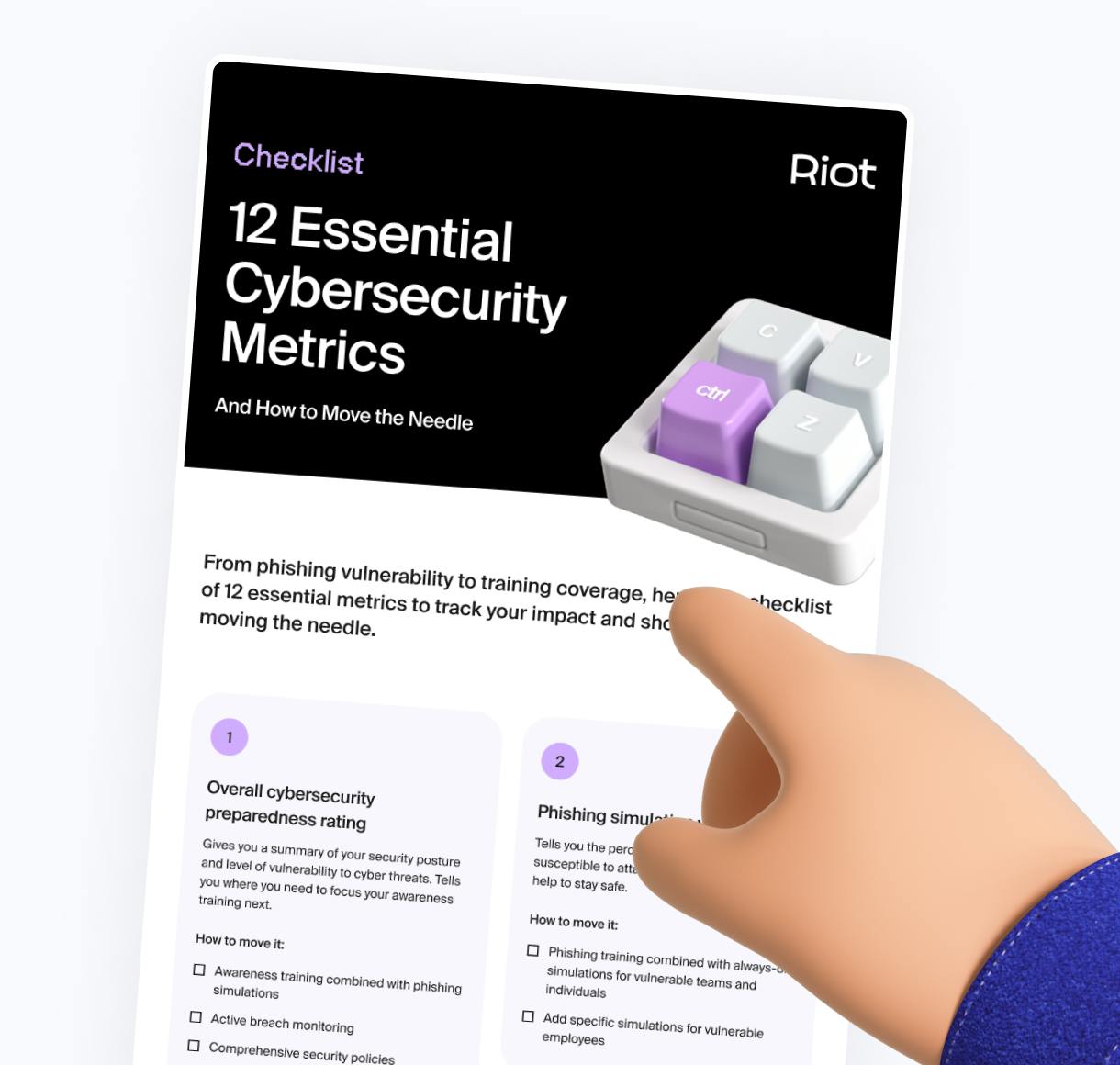
Want to know the 12 metrics to measure your company's cybersecurity level and impact? Download the free checklist
5 ways to build lasting habits with great ransomware training
Good ransomware awareness training isn't about instilling fear. Fear produces anxiety, and anxiety leads to more mistakes, not fewer. Effective training builds lasting habits: the automatic responses that kick in under pressure, even when an employee is busy, distracted, or being manipulated by someone who sounds entirely convincing.
Here's what good employee ransomware training looks like in practice:
- Short, frequent, and contextual training. Modules of under five minutes, delivered in the flow of work, consistently outperform quarterly or annual compliance sessions. The goal is to interrupt existing habits and replace them with better ones, and that takes repetition over time, not a single long module that employees forget about by lunchtime.
- Simulations with feedback loops, not shame. Phishing and ransomware training simulations are among the most effective tools available – but only when the follow-up teaches rather than shames. When an employee falls for a simulated attack, the immediate response should be to show them exactly what they missed – and what to do differently next time.
- Role-based scenarios. The threats a CFO faces — fraudulent payment approvals, spear-phishing impersonating board members, voice-cloned requests — are entirely different from those facing a software engineer or an HR professional reviewing CVs. Effective ransomware prevention training reflects the actual attack scenarios each role encounters and the specific red flags they should be looking for.
- A culture of reporting. The most underrated ransomware defense isn't a technology; it's an employee who reports a suspicious email quickly. Training should make flagging threats feel safe and routine, not like admitting a mistake. Every unreported near-miss is a missed opportunity to get ahead of an attack.
- Integration with broader cyber hygiene. Ransomware training is one layer of defense, but it can't stand alone. For training to reduce real risk, it has to sit alongside a deliberate effort to build a stronger overall cyber posture covering passwords, MFA, device hygiene, and data management.
Which brings us to the next piece of the puzzle…
How Employee Security Posture Management changes the equation
Even the best ransomware prevention training has a blind spot: it changes what employees know and how they act going forward, but it doesn't always fix unknown vulnerabilities that already exist right now.
That’s where Employee Security Posture Management (ESPM) comes in. ESPM is the practice of continuously scanning, scoring, and remediating the human vulnerabilities in your organization. It’s not about waiting for a breach or relying on employees to find and remedy unsafe practices themselves.
The best way to think of it is as the human equivalent of a vulnerability scanner. Instead of finding unpatched software, it finds vulnerable human behaviors and potentially exposed data before attackers can exploit them.
Here are five ways ESPM tools can help decision-makers go beyond simple ransomware training and proactively reduce the attack surface bad actors can work with:
- Identifying insecure document sharing. Files shared externally with "anyone with the link," sensitive data sitting in unsecured drives, and folders giving too many people access to too much — ESPM tools can surface these before they become a potential entry point for an attacker.
- Remedying poor cyber hygiene signals. Weak or reused passwords, unpatched personal devices accessing corporate tools, and accounts without MFA enabled — these are the kinds of conditions that make ransomware attacks possible. In these situations, training alone won’t stop ransomware attacks from happening.
- Tracking shadow IT exposure. Employees using unauthorized apps can create unmonitored data pathways and unexpected entry points. ESPM exposes these.
- Surfacing dormant risk. Vulnerabilities that have been present for months or even years, quietly widening the attack surface while everyone assumes training has covered it. With ESPM tools, we can find what's been hiding in plain sight.
- Making security real with the right metrics: Great phishing and ransomware training builds the habits people need; posture management tracks whether those habits are actually making the organization more secure.
Great ransomware training changes long-term behavior. With ESPM, we can mitigate the exposure that already exists and flag new vulnerabilities as they emerge. By pairing great training with ESPM, we can address both the human habits that create risk and the structural conditions that enable attacks.
And there’s one more thing to remember, too.
Why good ransomware training is a conversation for your whole board, not just for IT
Ransomware training fails the moment it becomes IT's problem, rather than being everyone's concern. When security is siloed in one department, it sends a message – however unintentionally – that everyone else is off the hook.
The organizations that get this right are the ones where executives don't just sign off on training programs but visibly participate in them: taking the same modules as everyone else, talking openly about phishing attempts they've spotted, and actively rewarding the people who speak up and report something suspicious.
Imagine a scenario where a CEO receives a convincing phishing email and, instead of quietly deleting it, forwards it to the wider team with the subject line ‘What gave it away?’ and a detailed breakdown of what is so phishy about it. This single act does more to normalize a culture of online safety than any mandatory annual training program.
It's also increasingly a matter of regulatory expectation. Frameworks like NIS2 are sharpening their focus on shared executive accountability for cybersecurity, which means ransomware training and proactive defense aren't just best practises anymore; they belong at the top of every executive's agenda.
Read more: Your Guide to NIS2 Compliance – And Our Free Cybersecurity Checklist
Give your team ransomware training that really works
Effective ransomware training doesn't just scare people into avoiding links. It changes behavior by showing employees how to reduce their own exposure, building the kind of instincts that hold up under pressure, not just in a training session.
But behavior change alone isn't enough. The organizations that come out ahead are the ones that combine strong training habits with a clear, continuous picture of their actual security posture. They know which vulnerabilities exist right now, not just which ones their employees have been taught to avoid in the future.
That's exactly what we've built at Riot. Our real-time security monitoring helps companies develop a stronger, shared security posture — not by pointing fingers, but by proactively spotting potential vulnerabilities like weak password protections or unsafe file permissions, and guiding people to resolve them before they become a problem.
If you want your team to be genuinely prepared for ransomware, we can help. Chat to one of our experts today and find out how Riot can help you deliver security training that really makes a difference.