Key takeaways
- Security awareness training only reduces risk when it changes habits, not just what people know.
- Habits stick through repetition and positive feedback. Every report – even false alarms – should be seen as another step towards a stronger security culture.
- Lasting habits take time. In a well-known study, habits took a median of 66 days to form.
- Short, frequent lessons in the tools people already use beat an annual module.
- Measure behavior, not attendance: reporting rate, time to report, click rate by difficulty, and repeat clickers.
Why employees click – even when they know better
Most employees can quickly spot a phishing email in a quiz. Then a busy Wednesday hits, and an "urgent" invoice lands in their inbox. In the chaos of it all, they click, even though they learned they should double-check.
A human element played a part in 62% of breaches in Verizon's 2026 Data Breach Investigations Report. This signals a habit problem rather than a knowledge one: people know the rules, but a rushed or stressful moment beats a remembered lesson. That's why security awareness training best practices focus on changing what people do automatically, under pressure, with nobody watching.
This guide is for CISOs, IT managers, and the leaders who fund their programs. It covers why most cybersecurity awareness training for employees fails to stick, how security habits actually form, eight best practices, a 90-day plan, and the mistakes that undo progress.
For the wider picture of how a mature program fits together, see our guide on security behavior and culture programs.
Why most security awareness training doesn't stick
Annual, hour-long modules are built to produce compliance records, not behavior change. Four problems often emerge:
- Forgetting: People tend to lose a lot of new information within days unless it is revisited, so a course taken in March has largely gone by April.
- The wrong moment: A module completed in a calm hour doesn't prepare anyone for a rushed payment request at 5:40 pm on a Friday.
- Evolving threats: AI-written phishing, deepfake voice calls, QR codes, and lures in Teams or Slack now arrive faster than yearly content can be updated.
- The wrong metric: Completion rates measure attendance, not risk. A 100% completion rate can sit alongside rising click rates.
The fix isn't more content. It's a different design: small, repeated, relevant practice. To build it, you first need to understand how habits form.
How security habits actually form
A habit is a loop. A cue (a suspicious request) triggers a routine (pause, verify, report), and a reward (quick, positive feedback) makes the routine more likely next time. Good training rehearses the whole loop, not just the middle step.
Take a fake invoice. The cue is the unexpected payment request. The routine is to stop, phone the supplier on a known number, and report it. The reward is a quick "thanks, good catch" from the security team. Practice that loop a few times, and it starts to run without effort.
How long does it take?
In a well-known study, University College London researchers followed 96 volunteers building everyday habits and found a median of 66 days to reach automaticity, with individual estimates ranging from 18 to 254 days. People were observed for 12 weeks, so the longest estimates were extrapolated, and missing the odd day didn't derail the process.
Security behaviors are more complex than eating fruit at lunch, so treat 66 days as a planning guide, not a promise. The takeaway is that one session can't build a habit, but steady repetition can.
The three levers
Three levers speed up the building of new security habits:
- Repetition: Regular practice brings key lessons back before they fade.
- Ease: Make the secure action the easiest one: SSO, a password manager, a one-click report button.
- Positive feedback: Praise reports, thank people for false alarms, and never shame a click.
Keystone security habits
Aim at a handful of keystone habits instead of twenty topics. These are the ones we'd start with:
- Pause before acting on urgency
- Verify payment or credential requests out of band
- Report anything odd
- Use MFA and a password manager
- Think before pasting data into AI tools
8 security awareness training best practices for lasting habits
Each of these practices maps to a lever in the habit loop: a clearer cue, an easier routine, or a better reward. You don't need to adopt all eight at once. Start with the first three, which create the foundation, then add the rest as your program develops. Together, they make up a practical security awareness program that people actually follow, not just complete.
1. Start with a baseline and pick the few behaviors that matter
Run a baseline phishing simulation and review your incident data before you build anything. Then choose three to five target behaviors, such as reporting suspicious messages or verifying payment changes, instead of covering 20 topics at once. A short list gives you something you can actually measure. Your helpdesk tickets are a free source of evidence on what people struggle with.
2. Train little and often
Replace the annual module with three- to five-minute lessons every week or two. Spaced repetition brings each key lesson back just as it begins to fade, and short sessions fit into a working day without a fight over calendar time. The total hours may match the old course; the retention won't. Tie each lesson to a single behavior so the cue is clear.
3. Deliver training in the flow of work
Meet people where they already are: email, Slack, Teams or Google Chat, rather than a separate learning portal nobody opens. Add just-in-time nudges tied to real moments, such as a new hire's first week, tax season, or an external file share. Context turns a lesson into a cue, and a cue is what a habit needs. Consider tools that can highlight the risk of pasting sensitive or restricted information into AI tools, too – this is how a lot of breaches start.
4. Tailor by role and risk
Attackers tailor their lures, so your training should too. Finance needs invoice and payment-change fraud scenarios. HR needs payroll diversion and fake-candidate scams. Executives need deepfake and vishing scenarios. IT needs to practice spotting fake support requests, alongside malware and ransomware awareness training. People engage when the scenario looks like their own inbox.
5. Simulate realistic, multi-channel attacks, and coach, never shame
Go beyond email to SMS, QR codes, voice calls, and collaboration tools, where attackers now operate. Rate each simulation's difficulty, for example, with the NIST Phish Scale, which weighs the number of cues in a message against how well its premise fits the target audience. A rise in clicks then means something. After a click, offer a two-minute teachable moment, not a public scoreboard, and vary difficulty: if everyone passes, the test is too easy.
6. Make reporting the easiest habit
Reporting turns individual vigilance into team defense. Give people a one-click report button, tell them what happens next, and thank them every time, false alarms included. An unacknowledged report teaches people not to bother, so a fast, friendly reply is the reward that closes the habit loop.
7. Get leaders and champions to model the behavior
Executives should take the same training, talk about it openly, and share their own near-misses. When a CEO admits "I almost fell for this," reporting becomes normal rather than embarrassing. A network of security champions then keeps the topic visible in each team. Read more about cybersecurity leadership and building a cybersecurity awareness culture.
8. Measure behavior, not completion
Track what people do, not just who finished. The security awareness training metrics worth reporting are:
- Reporting rate: The share of simulated phishing emails reported.
- Time to report: How long the security team takes to hear about a threat.
- Click rate by difficulty: Clicks read against how hard the lure was.
- Repeat clickers: Whether coaching is working for the people at highest risk.
Aim for the reporting rate to overtake the click rate, and review the trend monthly rather than a single snapshot. Segment results by team and role so a hot spot isn't averaged away. Add a qualitative check too: a two-question pulse survey asking whether people feel confident reporting a mistake tells you whether your coaching tone is working.
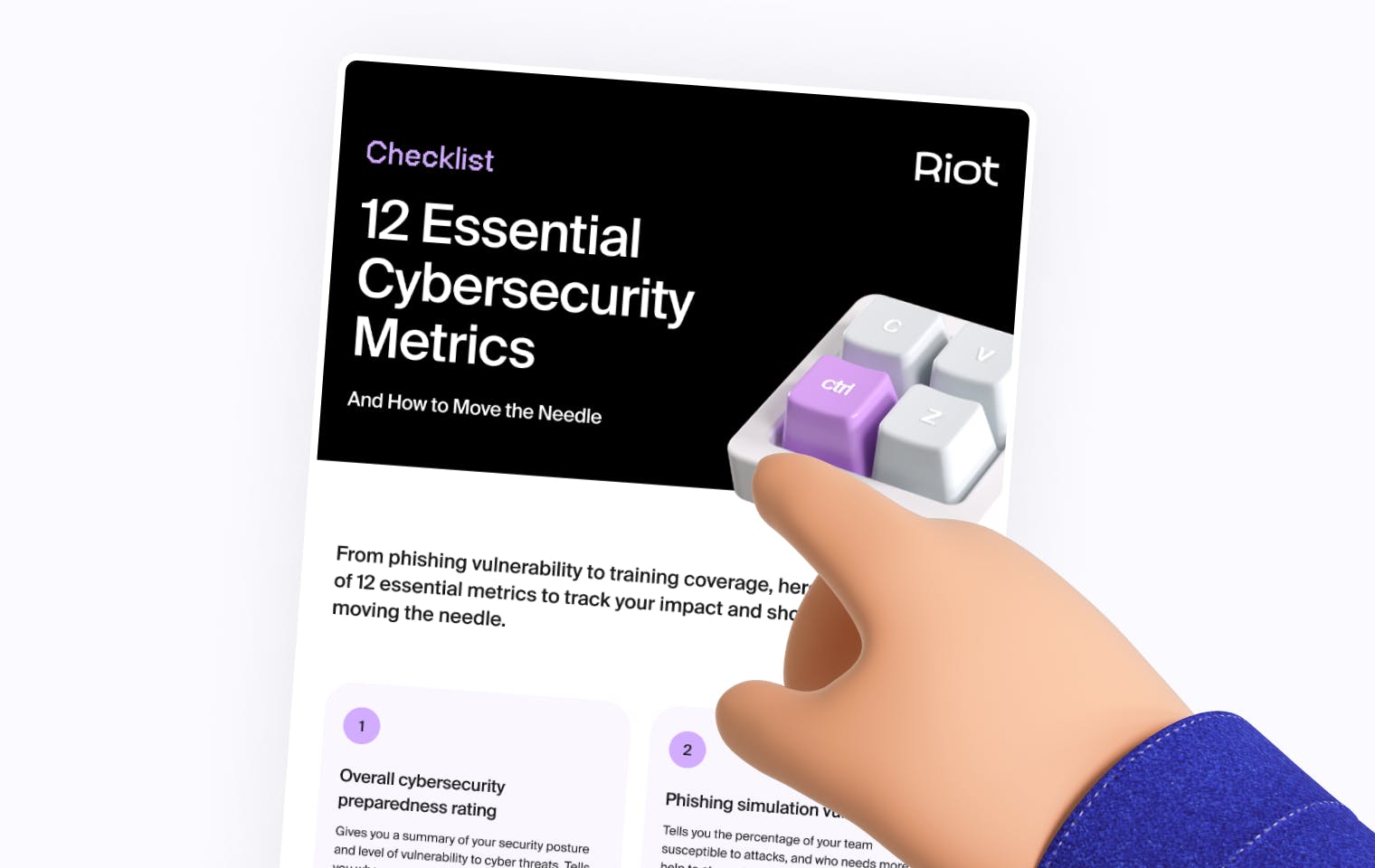
Speaking of metrics that matter, have you seen our free guide to 12 Essential Cybersecurity Metrics?
A 90-day plan to build security habits that work
Building the right habits takes time, effort, and resources. Here's how to start:
- Days 1–30, baseline: Win leadership buy-in, run a baseline simulation, pick your three to five target behaviors, and launch the report button. Agree who answers reports and how fast.
- Days 31–60, repetition: Start weekly micro-lessons, add role-based content, and run your first coached simulations. Check in with managers on who needs extra support.
- Days 61–90, reinforcement: Compare your metrics with the baseline, share the wins, adjust content to the threats you're seeing, and add multi-channel simulations. Then choose your next set of behaviors.
By day 90, look for three signals: a reporting rate above your baseline, a shorter time to report, and fewer repeat clickers. If reports have risen while clicks have barely moved, that is still progress, because people are noticing threats even when the lures are getting harder. Share those numbers with leadership early, so the program keeps its funding long enough for the habits to settle.
Habits keep strengthening after day 90. Treat this as a launch, not a finish line.
8 common mistakes that break good habits
- Treating training as a once-a-year compliance checkbox: A yearly event can't build a daily habit.
- One-way, unengaging content: If people click through to finish and remember nothing, you've bought a record, not a behavior.
- Generic content: Lessons that don't match people's jobs get ignored. See why one-size-fits-all training fails.
- Fear and shaming: Naming and shaming people who click teaches them to hide mistakes, which is the opposite of reporting.
- Unrealistic "gotcha" simulations: Tricking people with a fake salary-increase or bonus confirmation erodes trust, and it's a quick way to turn staff against the security team. West Midlands Trains learned this the hard way in 2021, when a fake bonus email sent as a phishing test angered and upset staff.
- Absent senior management: If leaders skip the training, everyone notices.
- Hard-to-find or ignored reporting: A report button nobody acknowledges soon stops being used.
- Measuring completion only: It tells you who finished, not who changed.
Awareness training that works
Lasting security comes from small, repeated, positive moments, not big annual events. Riot Awareness is built around that idea. In practice, it means:
- A coach, not a course: Albert, Riot's cybersecurity coach, trains people through short, tailored conversations and offers support when they need it.
- Training in the flow of work: Lessons arrive in Slack, Microsoft Teams, and Google Chat, scheduled around each person's calendar.
- Little and often: Regular bite-sized sessions provide the spaced repetition that turns knowledge into habit.
- Topics that match real risk: Social engineering, password management, digital footprint, GDPR and privacy, and real-life (IRL) security.
- No one left behind: Managers are told when someone needs extra help, which builds a shared security culture.
- Progress you can see: Clear metrics track each employee's journey from beginner to expert in real time.
- Compliance built in: Supports SOC 2 and ISO 27001, and integrates with Vanta, Drata, and Thoropass.
Want to see how it could work for your team? Get in touch with one of our experts today.
FAQ
Is security awareness training really that important?
Yes. Scams are a bigger threat than ever, and the damage and disruption keep rising. Your teams need help building good habits, not just knowledge.
How often should security awareness training be done?
Short monthly lessons at a minimum, plus onboarding, and weekly or every two weeks is better; once a year is not enough.
How long does it take to build a security habit?
The best-known research found a median of 66 days, with wide variation, so plan for at least 90.
How do you measure whether security awareness training works?
Track reporting rate, time to report, click rate by difficulty, and repeat clickers, not completion rates.
Should employees be punished for failing phishing simulations?
No. Coaching builds trust and reporting; punishment teaches people to hide mistakes.